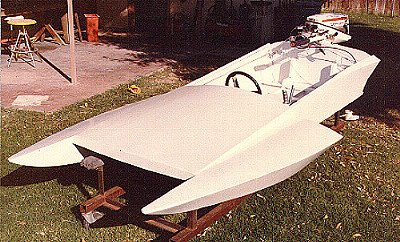
Hydroplanes are the boating equivelant of "open wheeled" race cars (eg. Formula 1, Formula Ford, etc), they have been designed purely for speed. That is the sole purpose of this boat design.
Also known as a "3 Point Hydroplane", the main characteristic of the hydroplane are the sponsons that are built lower than the main bulk of the boat. At speed, the boat will partly lift out of the water, leaving only the two sponsons and propeller (the 3 points) in contact with the water. This is how a hydroplane can have so much speed with relatively low horsepower, because there is less boat surface in contact with the water, causing drag.
The types of hydroplane design basically boil down to 2 types:1 - Conventional (rear seater)2 - Cabover (front seater)
The main differences are that a Conventional has the driver behind the motor and has a big round "shovel" nose, whereas a Cabover has the driver in front of the motor and a "pickle fork" front.
Conventional hydroplanes are older in design and generally slower than Cabovers. Although, a Conventional hydroplane with the right set-up can very much still battle against the newer, more efficient, Cabover designs.
TOP VIEW
Cabover on left, Conventional on right
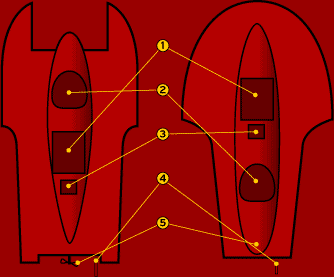
1 :Engine
2 :Cockpit - Lending explanation to the terms "Cabover" & "Rear Seater"
3 :Gearbox
4 :Rudder - The rudders are offset to either side of the back of the boat so the rudder can control the steering in the "clean" water, out of the propeller wash. As for which side of the boat ?? There is no hard & fast rule.
5 :Propeller - On a Conventional hydro, the propeller is located under the back of the boat
FRONT VIEW
Cabover on left, Conventional on right
This illustration directly illustrates the concept of the boat lifting out of the water at speed, showing only the sponson tips in contact with the water.
Notice the older design on the right with the higher centre of gravity, therefore not allowing the boat to turn easily.
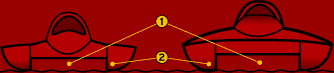
1 : Air Trap or Tunnel - This key to a hydroplane. The air is trapped by a sponson on either side and has to continue under the boat. This air pressure (when sufficient) will cause the boat to lift out of the water
2 : Sponsons
SIDE VIEW
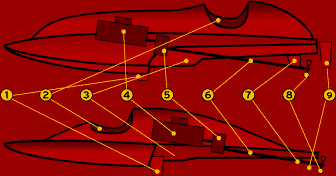
Conventional above, Cabover below
1 : Skid Fin - Due to most of the boat being out of the water, a fin is added so the boat has something to "grip" the water with as it turns
2 : Cockpit
3 : Air Trap - These panels keep the air trapped in the tunnel until further towards the back of the boat. These can be extended or shortened to fine tune the boats handling
4 : Engine
5 : Gearbox
6 : Propeller Shaft
7 : Skeg
8 : Propeller
9 : Rudder